

LOVE DATA WEEKStudent Data Viz Showcase
Congratulations to our 2026 Data Viz Student Champions:
Edward Kim and Drew Glassman from Indiana University (Data Viz #2)
winners of the LoveIt! Award category (chosen by popular vote)
Sakshi Sowmya-Aravind from Rutgers University (Data Viz #9)
winner of the Chart Topper - Judges' Award for Excellence (selected by the official judges' scoring rubrics)
For the 2026, students were provided with a College Fight Songs dataset and tasked with creating visualizations that bring this musical tradition to life.
#1
University of Illinois
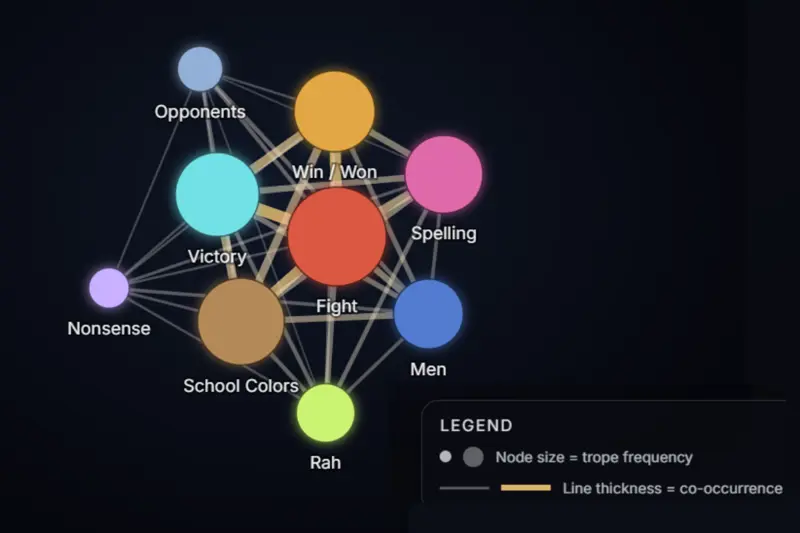
The College Fight Song Breakdown
Submitted by Andrea Turek
A visual tour of what colleges sing when they want to feel unstoppable. We treat fight songs like data: tropes, repetition, “rah” energy, and competitive language - then compare the rhetoric to reality.
#2
Indiana University
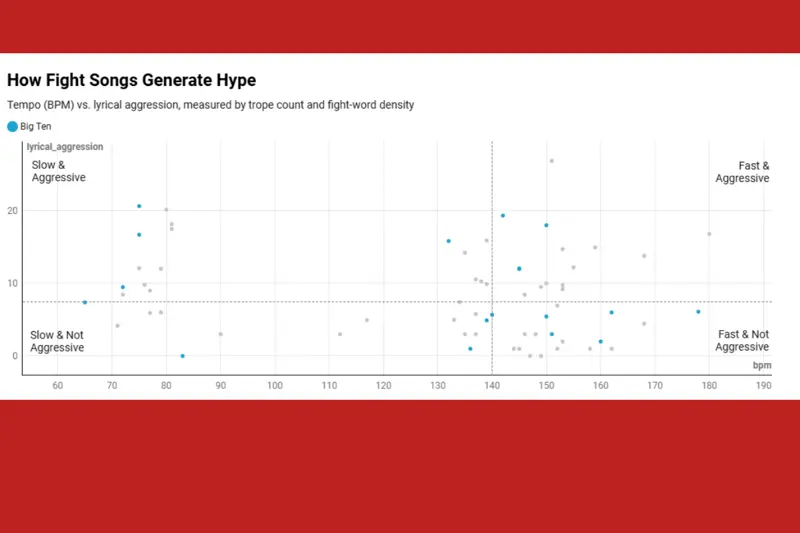
What Actually Makes a College Fight Song "Hype"?
Submitted by Edward Kim & Drew Glassman
Our project explores how college fight songs generate crowd energy by examining the relationship between musical tempo (BPM) and a composite measure of lyrical aggression derived from song lyrics. We used a two-dimensional framework to highlight distinct stylistic approaches to 'hype' and extend the analysis by examining how these styles appear across different Big Ten home-stadium environments.
#3
University of Iowa
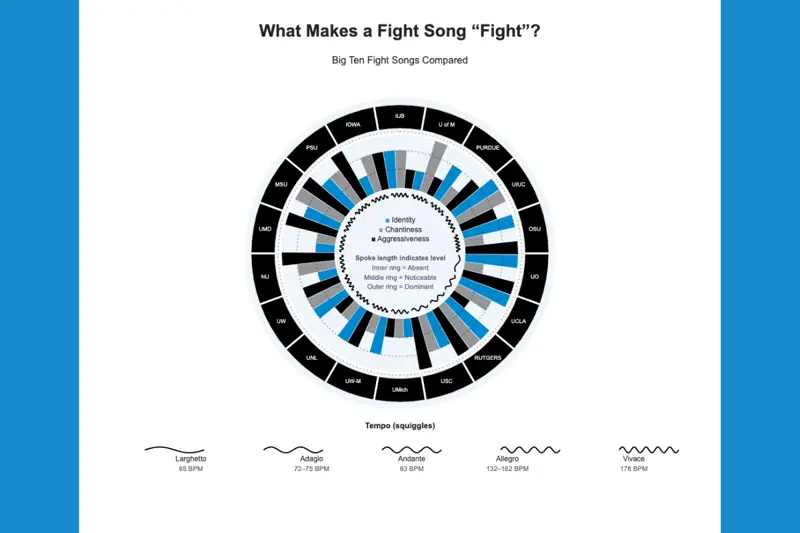
The Anatomy of Big Ten Fight Songs
Submitted by Srividya Ramanathan
This project examines Big Ten fight songs using two visualizations. The main visualization is a circular volvelle comparing compositional features across schools. The second visualization isolates one lyric feature and tracks it over time.
#4
University of Maryland
Feeling Fight Songs
Submitted by John Hooker
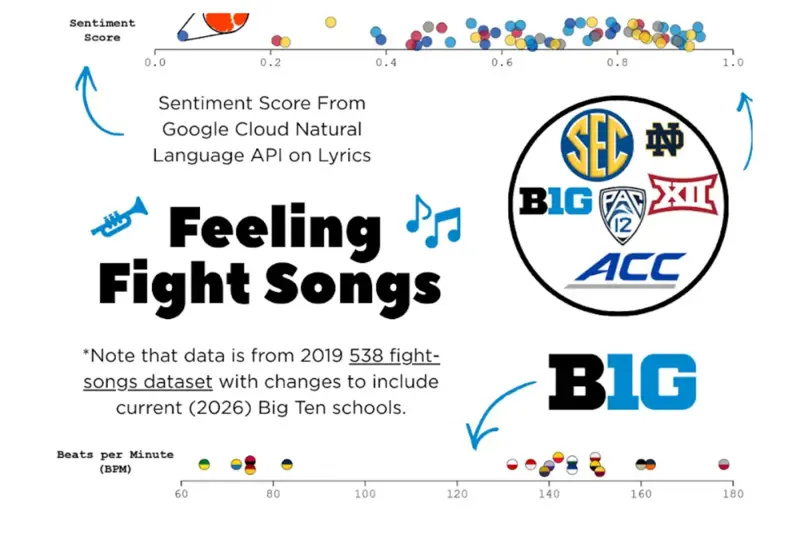
Most people associate feelings with songs so this analysis tries to understand some of the factors that change the feeling of the different fight songs. Firstly, the visualization is broken into two parts. A general conference level analysis is at the top (with outliers identified) and a filtered view of the Big Ten is at the bottom with colors such that each school is uniquely identifiable. Each view has 4 extracted features given in the original data (beats per minute, duration in seconds, the number of times “fight” is included, and the trope count) as well as a new variable of “Sentiment Score” which was calculated from running the Google Cloud Natural Language API on the lyrics of the fight songs. I gathered the fight song lyrics to the best of my ability mostly from official university websites (and in the case that something is wrong, the most likely error would be deviations in the number of times a section would be repeated which would hopefully not have too large of an impact on sentiment). These factors together give a picture of the feelings of collegiate fight songs.
#5
University of Michigan
Can You Chant This?
Submitted by Avril Yu
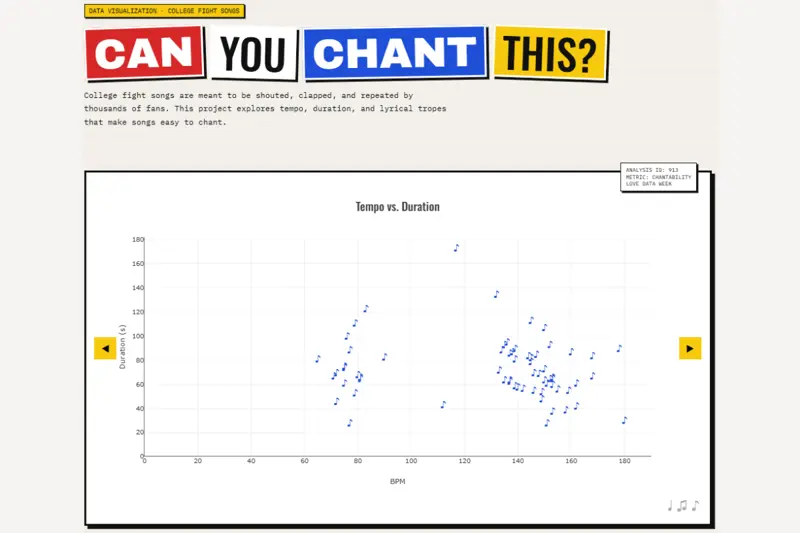
What's in a song? Music theory suggests that music follows its own set of laws, with some structures being more innately pleasing to the human ear than others. What, then, makes a "fight song" a fight song? What about it makes us want to shout our hearts out? This set of visualizations takes a look at elements such as tempo, duration, and tropes (typical words like "victory," "win," or the "rah rah" that quickens the blood of all true sports fans) to ponder these exact questions.
#6
University of Minnesota
Who Owns the Fight Song? - Elite Tradition or Mass Participation
Submitted by Roshini Senthil & Saitarun Evani
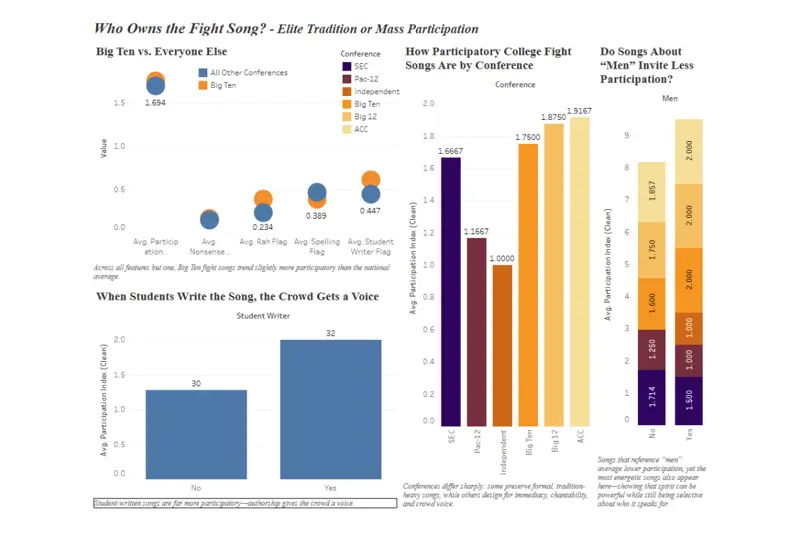
Who Are Fight Songs Really For? College fight songs are often treated as harmless rituals, but they are cultural artifacts. They encode who is being addressed, who is expected to sing, and whose voice is preserved. Some songs invite anyone in the stands through chants, spelling, and nonsense syllables. Others reflect elite tradition: formally written, historically fixed, and lyrically narrow. This project asks whether fight songs are designed for mass participation or elite tradition, especially within the Big Ten. We built a Participation Index from four crowd-oriented features: nonsense syllables, “rah” chants, spelling, and student authorship. Each song scores from 0 to 4, where higher values signal immediacy and crowd ownership. Using dot comparisons, bar charts, and stacked bars, the visuals compare the Big Ten to other conferences, student-written to institution-written songs, and inclusive versus exclusive language. Together, they reveal a tension at the heart of tradition: spirit can be powerful while still being selective about who it speaks for.
#7
Northwestern University
College Fight Song Trope Analysis
Submitted by Andre Bianchi and Sophia Perez
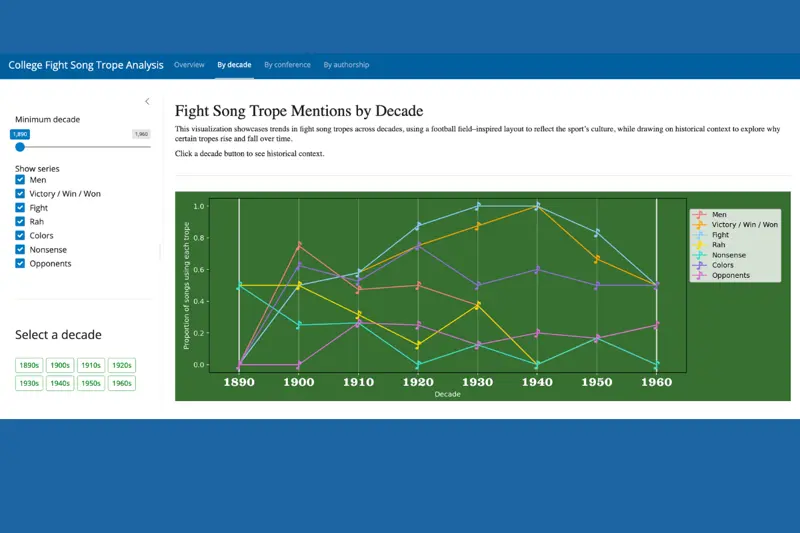
College fight songs are a unique intersection of music, athletics, and institutional identity. This project examines how common lyrical tropes, such as references to victory, opponents, school colors, and collective identity, have evolved across decades, by athletic conference, and by authorship.
#8
Purdue University
The Gold Standard
Submitted by Kinaya Hines
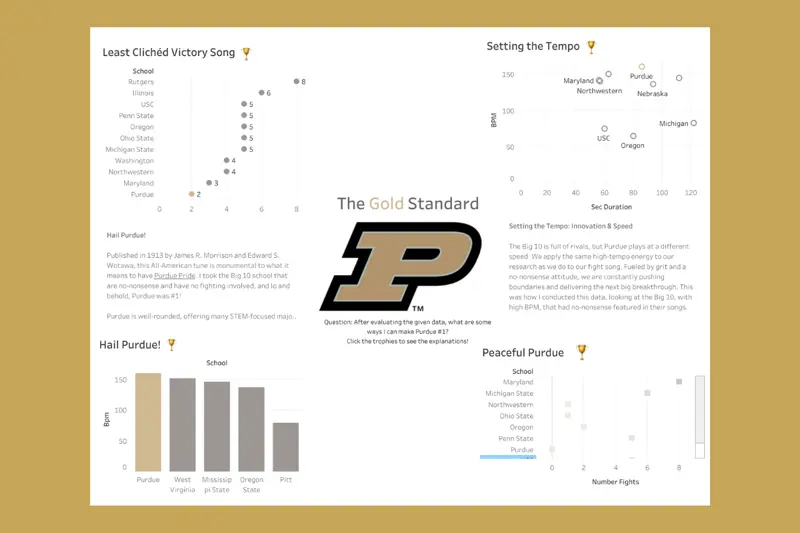
This visualization presents a playful yet analytical comparison of Big Ten university victory songs to highlight what makes Purdue distinctive. Through interactive elements, it groups schools based on characteristics such as lyrical clichés, musical tempo, tone, and thematic content. Instead of focusing on raw numbers, the dashboard uses these qualitative dimensions to tell a story: Purdue consistently rises to the top because its fight song is more original, faster‑paced, and more positive than its peers. The design blends data with narrative to show how Purdue’s musical traditions symbolically reflect its innovation, values, and culture.
#9
Rutgers University
Stadium Roar Quadrant Map
Submitted by Sakshi Sowmya-Aravind
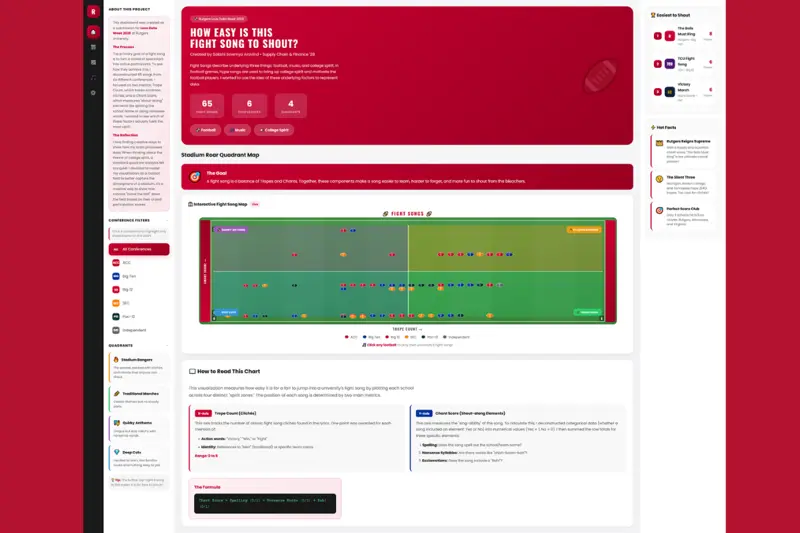
The primary goal of a fight song is to turn a crowd of spectators into active participants. This visualization measures how easy it is for a fan to jump into a university's fight song by plotting each school across four distinct "spirit zones."
#10
University of Wisconsin-Madison
The Geometry of College Fight Songs
Submitted by Barnabas Valko
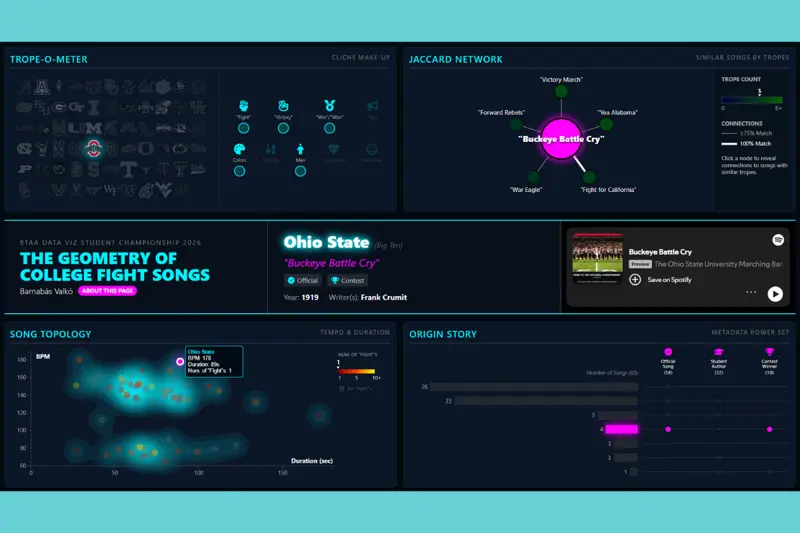
The dashboard contains four distinct data visualizations. The Trope-O-Meter quantifies lyrical clichés. The Jaccard Network connects songs by similar tropes—Song Topology plots tempo (BPM) against duration. Origin Story shows how songs were created. Clicking a logo analyzes that school’s fight song, activating a central info panel that displays the title, author, and origin, and includes an embedded Spotify player for the song.